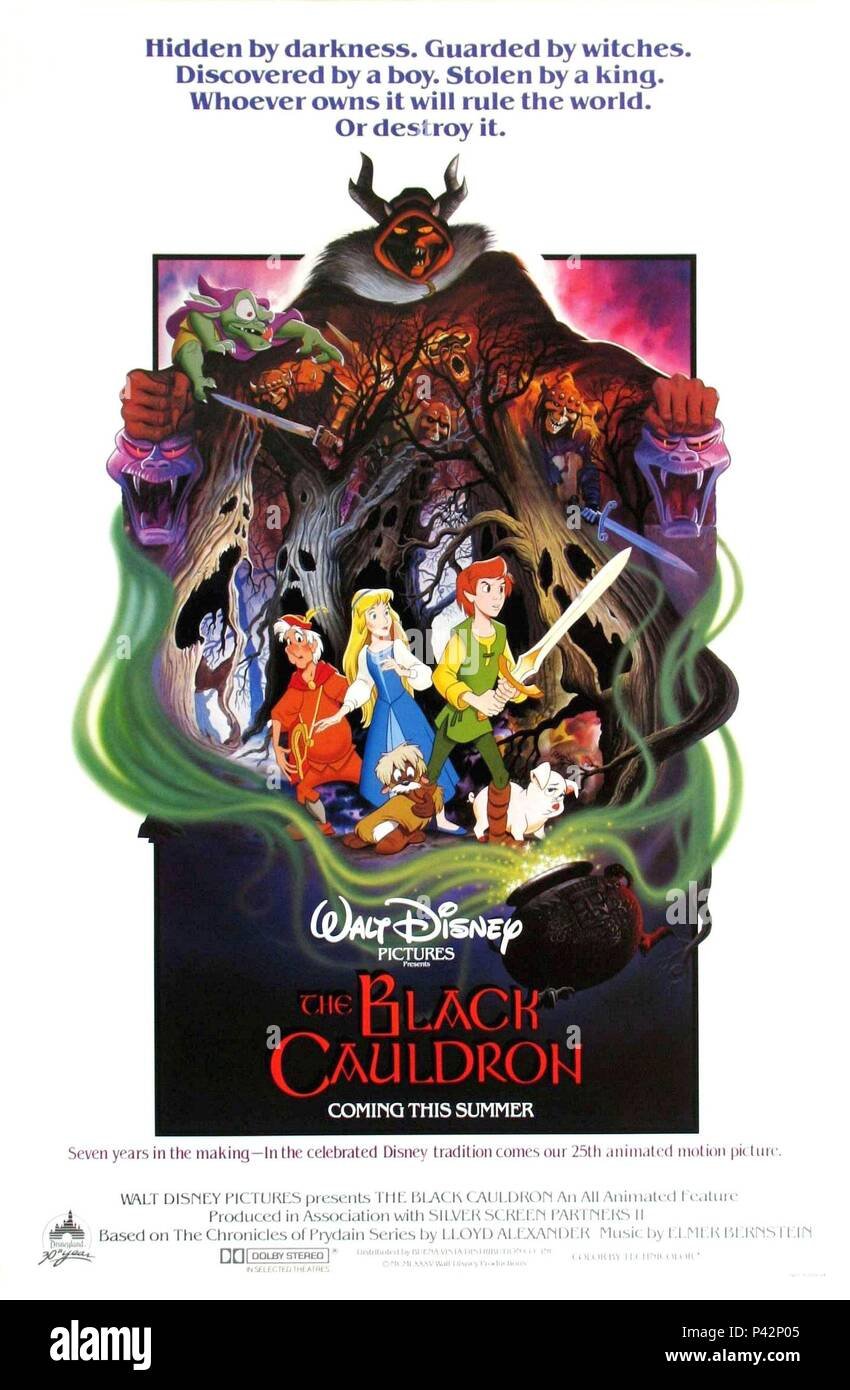
When we talk about animated film history, certain titles immediately spring to mind: the groundbreaking classics, the undeniable blockbusters, the cultural touchstones. Then there's The Black Cauldron. More than just a movie, this 1985 dark fantasy adventure represents a seismic shift in Walt Disney Productions' history – a pivotal, often painful, chapter detailing The Black Cauldron Film Production, Rocky Reception, and Cult Legacy. It's a tale of ambitious vision, creative clashes, commercial failure, and an eventual, unexpected redemption, making it one of the most fascinating and misunderstood entries in the Disney canon.
For decades, Disney built its empire on enchanting fairy tales and heartwarming narratives. The Black Cauldron, with its sinister Horned King, undead armies, and a genuinely grim tone, shattered that mold, venturing into territory few animated films dared to explore at the time. It was an audacious experiment, born from a desire to appeal to a broader, more mature audience, but one that ultimately cost the studio dearly before finding its footing as a beloved, albeit dark, cult classic.
At a Glance: The Cauldron's Troubled History
- Dark Departure: Disney's first foray into true dark fantasy, aiming for a PG rating and a wider audience.
- Costly Ambition: The most expensive animated film ever made at its time, with an actual budget of $44 million.
- Creative Conflict: Plagued by a lengthy, complex production process marked by director changes, story revisions, and executive interference.
- Box Office Bomb: Grossed only $21.3 million domestically, earning it the grim moniker, "the film that almost killed Disney."
- Delayed Redemption: Withheld from home video for over a decade due to poor performance, only to find a passionate cult following years later.
- Technical Pioneer: One of the first animated films to extensively use computer-generated imagery (CGI) for various elements.
- Literary Roots: Loosely adapted from Lloyd Alexander's acclaimed "The Chronicles of Prydain" series.
The Seed of Darkness: From Prydain to Disney's Drawing Boards
The journey of The Black Cauldron began not in a Disney story room, but within the pages of Lloyd Alexander's "The Chronicles of Prydain," a beloved five-novel series published between 1964 and 1968. Drawing heavily from Welsh mythology, Alexander crafted a richly imagined world, following the coming-of-age adventures of a young assistant pig-keeper named Taran, as he confronts ancient evils and discovers his own destiny.
Disney, always on the lookout for compelling stories, acquired the film rights to the first two books of the series – "The Book of Three" and "The Black Cauldron" – in 1971. Pre-production officially kicked off in 1973, marking the beginning of what would become an unusually long and arduous creative process. The initial vision was clear: produce a PG-rated animated feature, a departure from Disney's traditional G-rated fare, to tap into a more mature audience seeking adventure and fantasy beyond talking animals and singing princesses. This ambition, however, would prove to be both the film's greatest strength and its ultimate undoing.
Forging the Cauldron: A Decade of Production Pains
Bringing Prydain to life was anything but straightforward. The production for The Black Cauldron officially began in 1980, nearly a decade after the rights were acquired, and would span five intense years. This extended timeline was indicative of the deep-seated challenges and creative turmoil that defined the film's making.
Shifting Artistic Visions and Leadership
Early concepts for the film saw the Horned King, the story's terrifying antagonist, envisioned as a Viking lord by artist Vance Gerry. However, when Joe Hale took over as producer in 1980, he steered the artistic direction towards a more spectral, haunting presence. Hale redesigned the Horned King into the iconic, hooded figure with glowing red eyes we know today, a truly chilling villain for a Disney film. He also advocated for a visual style reminiscent of Disney's classic Sleeping Beauty (1959), aiming for grandeur and intricate detail. Legendary animator Milt Kahl was even brought out of retirement to contribute character designs, lending a sense of classic Disney craftsmanship to the project.
Yet, despite these efforts, the production struggled with its narrative. Story revisions were frequent, leading to the departure of screenwriter Rosemary Anne Sisson. Initial director John Musker (who would later direct The Little Mermaid and Aladdin) was also removed due to creative differences, replaced by Ted Berman and Richard Rich. This constant churn in leadership and vision often fragmented the creative process, making it difficult to maintain a consistent tone and direction.
Pioneering Technology and Budgetary Burdens
The Black Cauldron pushed technological boundaries for Disney animation. It was the studio's first animated feature to incorporate computer-generated imagery (CGI). While subtle by today's standards, elements like bubbles, a boat, an orb of light, and the ominous cauldron itself were rendered with this new technology. This pioneering effort showcased Disney's willingness to innovate, even as it added to the film's escalating costs.
Financially, the film became an albatross. Executives initially budgeted it at $25 million, but the true cost ballooned to a staggering $44 million. At the time, this made The Black Cauldron the most expensive animated film ever produced, a fact that would loom large over its eventual release and reception. The pressure to justify this monumental investment was immense, and it undoubtedly influenced the crucial decisions made in the final stages of production.
The Voices of Prydain
Despite the production woes, the voice cast assembled for The Black Cauldron delivered memorable performances. Young Grant Bardsley brought an earnest, if sometimes naive, quality to Taran, the ambitious assistant pig-keeper. Susan Sheridan voiced the feisty Princess Eilonwy, whose intelligence and bravery provided a strong foil to Taran. Character actor John Byner offered a brilliant dual performance, crafting the unique, badger-like voice of Gurgi – described as having a "child's inflection" – as well as the grumpy dwarf Doli. Freddie Jones lent gravitas to the wise Enchanter Dallben, and Arthur Malet captured the quirky charm of King Eidilleg.
However, the standout performance often cited is John Hurt as the Horned King. Hurt's chilling, gravelly voice imbued the villain with a truly menacing presence, making him one of Disney's most genuinely terrifying antagonists. The esteemed John Huston served as the film's narrator, his resonant voice grounding the fantastical tale.
Adding to the film's dark mood was the musical score composed and conducted by the legendary Elmer Bernstein. Bernstein utilized the ondes Martenot, an early electronic musical instrument, to create an eerie, otherworldly soundscape that perfectly complemented the film's tone. Unfortunately, much of Bernstein's intricate score was significantly cut or rearranged during the film's last-minute revisions, a common casualty in a production struggling for coherence.
A Cauldron of Conflict: The Plot Unfolds
Set in the mythical land of Prydain, the film plunges viewers into a world balanced precariously between ancient magic and looming darkness. Taran, an assistant pig-keeper dreaming of valor, finds his ordinary life shattered when his oracular pig, Hen Wen, is targeted by the wicked Horned King. The king, a skeletal, malevolent sorcerer, seeks an ancient artifact: the Black Cauldron, a vessel of immense dark power capable of raising an invincible army of undead warriors, the Cauldron-Born, to conquer the world.
Taran's mission to protect Hen Wen quickly spirals into a grand adventure. He encounters the wild, loyal, and sometimes irritating Gurgi; the spirited and intelligent Princess Eilonwy; and the cowardly but ultimately good-hearted bard, Fflewddur Fflam. Together, this unlikely fellowship navigates perilous landscapes, from the Horned King's oppressive castle to the mystical realm of the Fair Folk.
Their quest leads them to the formidable Marshes of Morva, where the Black Cauldron is guarded by three eccentric and powerful witches: Orddu, Orgoch, and Orwen. In a desperate bargain, Taran trades his newfound magic sword for the cauldron, only to learn that it is indestructible. Its power can only be broken if someone willingly sacrifices themselves by climbing into its depths, an act that proves fatal.
Captured by the Horned King, Taran and his friends witness the horrific raising of the Cauldron-Born. It is Gurgi, the creature Taran initially found exasperating, who performs the ultimate act of friendship. As Taran prepares to sacrifice himself, Gurgi leaps into the cauldron, shattering its dark magic and destroying both the Cauldron-Born and himself. The cauldron then consumes its surroundings, dragging the Horned King into its depths, violently ripping him apart and obliterating his castle.
In a poignant turn, the witches return to reclaim the inert cauldron. Taran, understanding the true value of friendship, bargains the cauldron and his magic sword for Gurgi's revival. The witches comply, restoring Gurgi to life. The film concludes with Taran and Eilonwy sharing a tender kiss, and the four friends returning to Dallben, their heroic journey complete, and Taran's dreams of valor realized in a way he never expected.
A Chilling Debut: The Rocky Reception and Box Office Bomb
After a tumultuous production, The Black Cauldron was initially slated for a Christmas 1984 release. However, a fateful test screening revealed a critical problem: certain scenes, particularly the climax involving the Horned King's demise and the undead Cauldron-Born, were deemed far too disturbing for children. Walt Disney Studios chairman Jeffrey Katzenberg, alarmed by the strong negative reaction, ordered significant cuts, delaying the film's release to July 24, 1985. These last-minute edits further compromised the film's narrative coherence and artistic integrity, a common consequence of executive interference driven by commercial anxieties.
Upon its release, The Black Cauldron was met with mixed reviews from critics. Many praised its ambitious animation, stunning visuals, and the genuine sense of dark fantasy it brought to the screen. John Hurt's performance as the Horned King was frequently singled out for its chilling effectiveness. However, critics also pointed to its disjointed narrative, inconsistent pacing, and an ending that, despite the cuts, still felt remarkably grim for a Disney film. Some found the characters less engaging than those in classic Disney tales, while others simply weren't ready for a Disney film that eschewed the studio's traditional warmth for a darker tone.
But it was at the box office where the film truly stumbled. Despite its record-breaking $44 million budget (the most expensive animated film at the time), The Black Cauldron grossed a mere $21.3 million domestically. This commercial failure was catastrophic for Walt Disney Productions, jeopardizing the very future of its animation department. The film quickly earned the infamous nickname, "the film that almost killed Disney," a stark reminder of the financial risks associated with creative experimentation.
The domestic failure was so severe that Disney opted not to release The Black Cauldron on home media for over a decade, a highly unusual move for a major animated feature. It wouldn't see a VHS release in the US until 1998 (though it did appear in the UK in 1997). This long delay likely contributed to its initial obscurity for a generation of viewers.
Interestingly, the film fared much better internationally, particularly in France. There, The Black Cauldron attracted 3,074,481 admissions, making it the fifth most attended film of the year. This stark contrast suggests that European audiences, perhaps more accustomed to darker fairy tales and animated features, were more receptive to Disney's ambitious tonal shift.
Rising from the Ashes: The Cauldron's Cult Legacy
Despite its initial rejection, The Black Cauldron has steadily gained a dedicated cult following over the decades. The long wait for home media releases meant that when it finally became available, a new generation discovered its unique charm and darker appeal.
A Second Life on Home Media
The film's journey through home media reflects its gradual re-evaluation. Following its limited theatrical run, The Black Cauldron first saw a VHS release in the UK in 1997, followed by the US in 1998. Its DVD debut came in 2000, allowing for a clearer, sharper viewing experience. A "25th Anniversary Edition" DVD was released in 2010, signaling Disney's recognition of its burgeoning fan base. More recently, the film has enjoyed a 4K release on Disney+ in 2019 and a Blu-ray release in 2021, ensuring its continued availability and preservation.
This slow but steady presence on home video platforms allowed The Black Cauldron to shed the weight of its original box office failure. Viewers, no longer constrained by the expectations of a theatrical release, could appreciate the film for what it was: a visually stunning, genuinely dark fantasy adventure that dared to be different.
Why a Cult Classic?
The reasons for its cult status are manifold:
- Uniqueness: It stands out within the Disney canon. Its willingness to embrace darker themes, complex characters, and a grittier aesthetic makes it appealing to those who appreciate animation beyond traditional "family-friendly" fare.
- Artistic Merit: Despite its narrative flaws, the animation quality, character designs (especially the Horned King), and the atmospheric score are undeniable. Many re-evaluating the film now recognize its technical achievements.
- Nostalgia: For many who first saw it as children, the film holds a powerful nostalgic grip. Its frightening elements and mature themes left a lasting impression, fostering a deep connection that transcends critical consensus.
- Underdog Appeal: Its reputation as "the film that almost killed Disney" gives it an underdog allure. Fans often feel a sense of pride in championing a film that was initially dismissed.
- Relevance to Modern Fantasy: In an era where dark fantasy franchises like Game of Thrones or Harry Potter dominate, The Black Cauldron's pioneering spirit feels more relevant than ever.
Enduring Echoes: Legacy and Influence
While The Black Cauldron didn't immediately launch a new era for Disney animation, its legacy is undeniable and multifaceted. It served as a vital, if painful, learning experience for the studio, demonstrating the challenges of straying too far from established brand identity while also pushing the boundaries of what animated films could be.
A Turning Point for Disney
The film's commercial failure forced a critical re-evaluation within Disney's animation department. It highlighted the need for stronger narratives, more cohesive creative leadership, and a clear understanding of audience expectations. In a paradoxical way, The Black Cauldron's missteps paved the way for the "Disney Renaissance" of the late 1980s and 1990s, where films like The Little Mermaid, Beauty and the Beast, and The Lion King combined classic storytelling with modern animation techniques and strong musical numbers. The lessons learned from the Cauldron's production informed subsequent triumphs.
Beyond the Screen: Parks, Games, and Cameos
The Black Cauldron's characters and themes have popped up in various corners of the Disney universe:
- Disney Parks: Characters from the film have made appearances in Disney Parks. Notably, the film inspired an attraction at Tokyo Disneyland which ran from 1986 to 2006.
- Video Games: In 1986, Sierra On-Line released a graphic adventure video game titled The Black Cauldron, based on the film. More recently, characters have appeared in the mobile game Disney Magic Kingdoms.
- Cameos: Taran, Eilonwy, Gurgi, and the Horned King have made cameo appearances in other Disney productions, including House of Mouse, Once Upon a Halloween, and the charming 2023 short Once Upon a Studio. These appearances serve to integrate the film back into the larger Disney tapestry, acknowledging its place in history.
The Promise of Prydain's Future
The enduring appeal of Lloyd Alexander's original books, combined with the cult status of the film, suggests that the world of Prydain still holds cinematic potential. In 2016, Walt Disney Pictures re-acquired the film rights to "The Chronicles of Prydain" with stated intentions for a live-action film series. While no further reports or concrete production plans have emerged since then, it speaks volumes that Disney continues to see value in this dark fantasy saga, hinting that Taran's adventures might yet return to the big screen in a new form.
Unearthing the Truth: Separating Myth from Reality
The Black Cauldron's dramatic history has inevitably led to some misconceptions and enduring questions.
The True Cost of Ambition
One common point of confusion revolves around its budget. While many sources cite the official executive budget of $25 million, the actual cost of production for The Black Cauldron soared to $44 million. This discrepancy highlights the immense financial pressures and potential mismanagement during its lengthy development. The $44 million figure solidified its place as the most expensive animated film of its era, making its box office failure even more painful.
"Too Dark for Disney": A Shifting Line
The claim that The Black Cauldron was "too dark for Disney" is often repeated, and while true for its initial reception, it's a statement that reflects a specific historical context. In the mid-80s, Disney's brand was synonymous with lighthearted family entertainment. The film's elements—a genuinely terrifying villain, an army of the undead, and a willingness to explore themes of sacrifice and real danger—challenged those expectations.
However, subsequent animated films, both from Disney (like The Hunchback of Notre Dame) and other studios (like Don Bluth's The Secret of NIMH or All Dogs Go to Heaven), demonstrated that audiences could embrace darker animation. The Black Cauldron was perhaps ahead of its time, pushing boundaries that the market wasn't quite ready for from the Disney brand. Today, in an era of complex superhero narratives and sophisticated fantasy epics, its darkness feels less transgressive and more like a pioneering effort in animated storytelling.
The Cauldron's Enduring Mystique
The Black Cauldron remains a fascinating paradox in Disney's history: a commercial flop that became a beloved cult classic, a creative misstep that inadvertently shaped the studio's future, and a film that dared to be different, even if it paid a heavy price. It’s a testament to the power of artistic ambition, the unpredictable nature of audience reception, and the enduring human desire for stories that explore the shadows as well as the light.
If you've never ventured into the mythical land of Prydain through Disney's lens, or if you dismissed it years ago, now might be the perfect time to revisit The Black Cauldron. Watch it not just as a piece of entertainment, but as a historical document – a brave, flawed, yet undeniably significant chapter in the grand tapestry of animated cinema. You might find yourself, like so many others, drawn into its unique, dark magic.